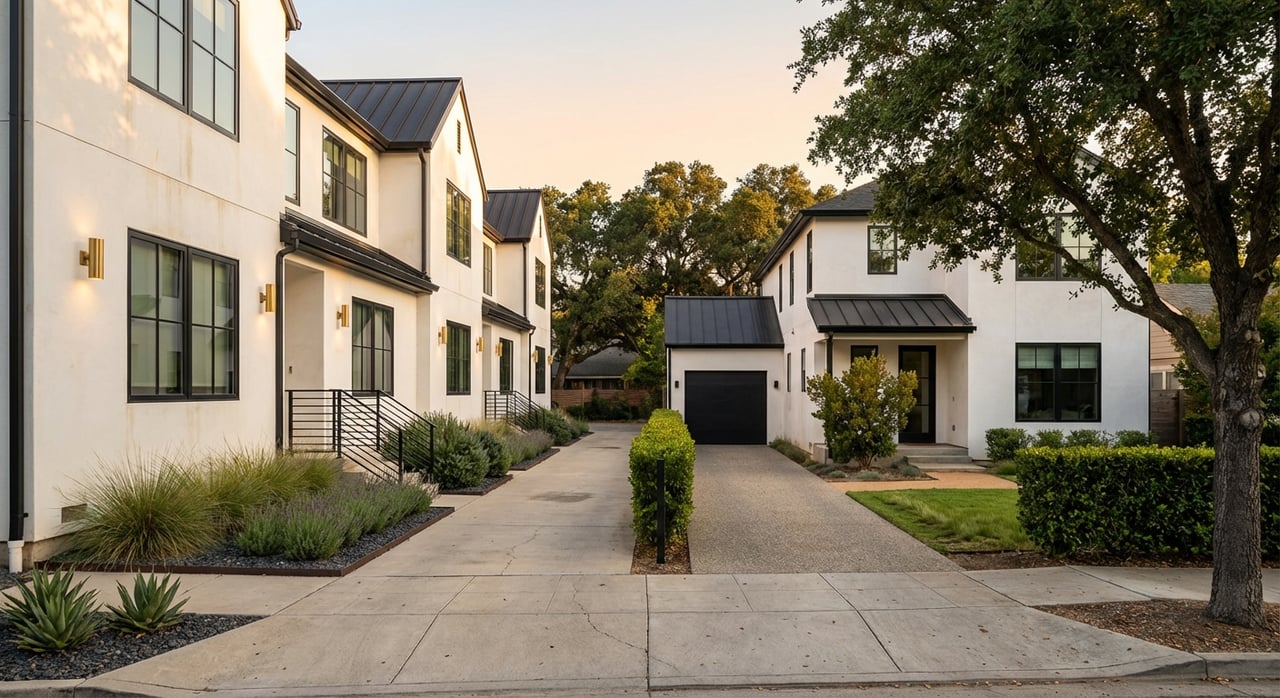
Dublin CA Townhome vs House: Which Suits You Best?
Trying to decide between a townhome and a single-family house in Dublin? You are not alone. With prices high across the Tri-Valley, your choice often comes down to tradeoffs in cost, space, flexibility, and day-to-day lifestyle. In this guide, you will learn how these options compare in Dublin, what ongoing costs to expect, how local rules like Mello-Roos and ADUs can affect your plans, and a simple cost example to help you budget. Let’s dive in.
Dublin’s housing market is competitive within the Tri-Valley. Recent reports show the citywide median sale price around $1.1 million, with nearby Pleasanton often higher and Livermore close to Dublin’s level. Within Dublin, townhomes typically sell well below detached single-family homes, with a recent median gap where townhomes hovered around the high $800,000s while many single-family homes landed near the low to mid $1.3–$1.4 million range. That gap is a key reason many first-time buyers start with a townhome.
Master-planned neighborhoods in Dublin, including areas like Wallis Ranch and parts of Dublin Ranch, continue to add supply. These communities often mix attached and detached homes, offer shared amenities, and may include special taxes that affect your annual costs. Understanding those details helps you compare homes on a true apples-to-apples basis.
If you are prioritizing a lower purchase price, a townhome usually wins in Dublin. Many local townhomes offer roughly 1,200 to 2,100 square feet with multi-level layouts and small private patios. Newer single-family homes often start around 2,400 square feet on larger lots and can reach 3,000 square feet or more. For a feel of current plan sizes, review builder pages like Trumark’s Fielding at Wallis Ranch, which shows both product types and typical footprints for the area (Fielding at Wallis Ranch).
The extra square footage and lot size in a house add privacy and outdoor usability. Townhomes save upfront cost, which can bring your monthly payment and cash-to-close down to a more comfortable level.
Townhome and condo communities often have monthly HOA dues. In Dublin, sample listings show HOA fees commonly around $300 to $600 or more per month, depending on age, amenities, and what the association covers. Some HOAs include building exterior maintenance and a master insurance policy for shared structures, which can reduce your personal maintenance tasks.
Detached homes frequently have lower or no HOA dues, but you cover all exterior maintenance and repairs yourself. A common budgeting rule of thumb is to reserve about 1 percent of the home’s value each year for maintenance, though the true figure varies by age, systems, and condition (annual maintenance rule of thumb).
Homeowners’ insurance costs vary by location and risk. California averages sit in the mid four-figure range per year, and it is smart to shop multiple carriers to compare coverage and price (California homeowners insurance overview). Property tax in Alameda County starts with a 1.0 percent Proposition 13 base rate, plus voter-approved bonds and special assessments that differ by neighborhood. Some newer Dublin areas also have separate Community Facilities District special taxes, often called Mello-Roos, which are added directly to the bill. You can look up a parcel’s current tax status through the county’s system (Alameda County tax lookup) and review details about Dublin’s CFDs on the city site (Dublin CFD information).
Many Dublin townhome and condo HOAs typically handle common-area landscaping, pool or clubhouse upkeep, exterior painting or roofing on multi-unit buildings, and a master insurance policy for shared areas. Coverage varies by community, so always request the current HOA budget, the most recent reserve study, insurance declarations, and meeting minutes. This is how you confirm what you pay for versus what the HOA handles, and whether any special assessments are planned. For insurance details, make sure you understand the HOA’s master policy type and any interior coverage gaps, then get an HO-6 quote to fill them (HOA insurance basics and coverage gaps).
Think carefully about your daily routine and priorities. Townhomes share walls and common spaces, which can mean less private outdoor area but simpler upkeep and built-in amenities. Single-family homes offer more separation from neighbors and larger yards, which many buyers value for entertaining or gardening. The tradeoff is more time and money spent on maintenance. If you travel often and want low maintenance, a townhome can be appealing. If you want a private yard for pets, hobbies, or future projects, a detached home may fit better.
Accessory Dwelling Units can be a useful way to add space or create rental income potential. Dublin permits ADUs and provides a helpful ADU manual, prototype plans, and certain fee waivers that are scheduled through 2026. Single-family lots are generally the most straightforward path for an ADU, with clear development standards on the city’s site (Dublin ADU resources and incentives). In attached communities, ADU possibilities depend on how the property is structured and whether the HOA allows it.
If you are considering renting your property, know that HOAs can regulate short-term rentals and may set rental caps, subject to California’s Davis-Stirling rules. Review the CC&Rs for rental terms and any approval steps before you buy (rental rules overview under Davis-Stirling).
For financing, some condos and townhome projects need to be on an approved list for FHA or VA loans. If you plan to use one of these loan types, confirm the project’s eligibility early to avoid delays (FHA condo approval basics).
Below is a simplified look at how monthly carrying costs can differ. Exact numbers will vary based on interest rate, down payment, property tax rate area, and HOA coverage.
Scenario A: $900,000 townhome
Scenario B: $1,350,000 single-family house
This exercise highlights how HOA dues and maintenance trade places. Your mortgage payment will depend on your loan terms. When you choose a property, pull the exact tax bill, HOA documents, and insurance quotes for a precise monthly total.
Use this list on your first tour or when drafting an offer. Ask for documents early so you can verify costs and rules.
Many buyers consider schools when choosing a home. Dublin Unified School District reports strong overall performance metrics at the district level, which can influence pricing across neighborhoods. Review objective district data and verify school assignments directly with the district or through official sources like Public School Review for context (Dublin Unified overview).
In Dublin, the choice between a townhome and a single-family house usually comes down to what you value most: affordability and low upkeep, or space, privacy, and long-term flexibility. Once you focus on the true monthly cost, HOA rules, tax details, and your lifestyle needs, the right answer becomes clear.
If you would like a side-by-side cost model for specific properties, a review of HOA documents, or guidance on ADU potential and Mello-Roos, connect with Nancy Renton for local, data-driven advice. Schedule a Free Consultation and make your next move with confidence.
Stay up to date on the latest real estate trends.






With a strong track record of successful sales and happy clients, Nancy’s commitment to excellence ensures top-tier service and outstanding outcomes.